"Chicano writers from El Paso are the most progressive, open-minded, far-reaching, and inclusive writers of them all."

Octavio Romano

Monday, March 14, 2011

Lunes con Lalo: Economics and the Chicano Movement


Lunes con Lalo
The Chicano Movement Some Not Too Objective Observations


Economics

By Abelardo "Lalo" Delgado
Share

I am aboard a Western jet, flying to Minneapolis to spend a couple of days with the Chicano brothers in the colleges there. I will be compensated with a thing they call an “honorarium” to the tun of $750. The plane ride cost $160. To my right, is a man, his wife, and three children, who are on this plane for the same purpose. It is a proper way to introduce this chapter on economics of The Movement.

One of the things I will do in Minneapolis is talk with Chicanos there about contributing to the National Chicano Aztlán legal defense. The trial in L.A. is on its last lap to pin Corky and Gurule on a charge of carrying two “pieces” with them. This weekend, there is a benefit in Denver, spearheaded by Ricardo Montalban for the educational funds of Tlatelolco and UMAS.

Everywhere you turn, the dollar sign is on top of our spiritual movement. There is, however, a very big difference. The dollar we speak about is usually in the control of Chicanos, and, by and large, for the improvement of Chicanos.

In the Southwest alone, Chicanos control over twenty million dollars worth of programs annually, and thousands of jobs. What we mean by “control of our own destinies” in the economic area at least, is beginning to happen. I would be the first to admit that we are still quite a way from this type of control being entirely true, since the question of dependency on the benevolent governmental agency, church or private foundation is still very ominous upon us.

The other fallacy about relating money to The Movement is that it is still very much a limited economic participation, and enjoyed by a handful of privilegiados. The masses of impoverished Chicanos who are La Causa and the very movement itself, remain intact and unaffected by the prosperous surge some of us would like to attribute to The Movement.

Those in the movement who see this huge discrepancy, or creation of major change in which greater portions, if not all, Chicanos can benefit, despair, and realize that as ugly as it may be to face it, some of us benefit directly from the movement and at times profit and enjoy advances economically. A new job, fatter paychecks, a new home, a new car, a color T.V., and a checking account.

There is, of course, those who rightfully enjoy these things and continue to remain sincere to their commitment – to assist others escape las garras de la probreza. A hang-up can also be bad about associating people who have money or positions as arbitrary enemies of the movement and write them off with our favorite cliché of “vendido." The question is: if you have money and a position, are you willing to use both for the advancement of our raza?

Last year, Joe Capp came over for a benefit in Denver, and a carnal, who was a little up on the copas, took the opportunity to hit Capp with a big question: “How come you don't help us with money?” Capp, true to his profession, took the question head on, and said, he had just recently learned of the Chicano Movement, and never really approached to help until then.

A new market as been opened with the Chicano Movement, the posters, the books, the buttons and medallions, the teatro, public appearances and rap, the music and even movies, but it must remain pure, uncontaminated by the profit demand and rather in the spirit of the comunidad de Aztlán; if we have, share and help; if we need, ask and take.

Bookmark and Share


Other parts of this series:

 
from The Chicano Movement: Some Not Too Objective Observations by Abelardo B. Delgado, (Denver: Colorado Migrant Council, 1971), prepared by the Colorado Migrant Council. Published with permission from the Delgado Family. Special thanks for Dolores Delgado. (c) Abelardo Delgado 1971, all right reserved. This may not be republished with out the permission of the Delgado estate.

Thursday, March 10, 2011

Top Ten Blog Post by Chicana(o)s in February 2011 on a Chicano(a) Writer Blog


Pluma Fronteriza, on monthly basis, puts together a list of the Top 10 Blog Posts by a Chicano(a) Writers on their own blog.There's a lot of good stuff from February, many experiences from the Big Freeze  of 2011. Both Michelle Otero, Sheryl Luna, and Daniel Chacon delve into this, if not in these blog posts I mention, in other posts.

Lorenzo Herrera y Lozano has two posts that made the list, as did Mario T. Garcia (his posts on Egypt and the cutting of funds for social programs from the Congressional budget). 

Some poems made the list: Rafael Jesus Gonzalez opens the Year of the Rabbit for us and Reyes Cardenas gives us a mummy duel and "Poor Mexican Women."

Michelle Otero and Sheryl Luna gives us continued thoughts on writing a la John Cougar "life goes on" in the everyday life of being a writer. When these books finally come out, I think I'll print these posts about their making and evolution, fold the posts then store them in Luna and Otero's books, respectively and, well... respectively. 

I'm sure El Guapo does not mean to be insensitive, but you got to admit the humor of his post. I admit, I laughed, so it makes #1.

Sheryl Luna's facts are not her own but from Vida: Women in Literary Arts on how much the top magazines in the United States publish women, so kudos to her for bringing this to our attention. Holy Shit, what we suspected all along.

Also, Sergio Troncoso's description of the working class and the "Packinghouse Poet" are a good read and appropriate as the Wisconsin legislature gives workers the shaft this morning. Then there's the always hilariaous Hells Nah's and her socially unacceptable rant. Several ties this last month. 


I know you see some of the same names from January making the list, but what you have below are some of the most Chicano@ prolific bloggers. Some other big (and small) writers blog, but not very much. You can see most of the blogs I track on the Pluma Fronteriza blog on the left side of the page. It also shows when the last time that writer posted. I'm always looking for new blogs I should track, and of course, they should be an author's own blog, and it doesn't matter how much you post either -- that is unless you want to make the Top 10.


Bookmark and Share

 Top 10 Blog Posts in February from a Chicano(a) Writer
Share


10. Some discouraging numbers/facts by Sheryl Luna on the Dialectical Migration Blog


10. Budget debate leaves out the least among us by Mario T. Garcia on the National Catholic Reporter Blogs page.


9. If it were socially acceptable by oh hells ha on the oh hells nah blog


8.  Full Moon Year of the Rabbit 4709 by Rafael Jesus Gonzalez on his self-named blog.


7. Poor Mexican Women and Mummy Duet by Reyes Cardenas on the Chicano Poet Blog


6. Packinghouse Poet by Sergio Troncoso on the Chico Lingo Blog 


5. Egypt, César Chávez and Nonviolence by Mario T. Garcia on the National Catholic Reporter Blogs page. 


4. What Now?, Part III: The Infant by Michelle Otero on the Vessel Blog


3. Today, Ricky Martin matters more than ever by Lorezno Herrera y Lozano on the Hairspray and Fideo Blog.


2. Frida's in the Rainbow Honor Walk, and I am not happy by Lorenzo Herrera y Lozano on the Hairspray and Fideo Blog 


1. Ice in the Desert by Daniel Chacon on the Chacon n Chuco Blog 


1. TOP 10 Valentines Games For People With Herpes by El Guapo on El JumpingBean Blog


Bookmark and Share

Wednesday, March 09, 2011

St. John of God: Patron Saint of Printers, Booksellers, Publishers


St. John of God
Patron Saint of Printers, Publishers, Booksellers
After spending some time in North Africa caring for an exiled family all of whom got sick while there, St. John of God returned to Spain where he began spending his time reading spiritual books. Loving books so much, he became a book peddler and went town to town selling book. Later, in Granada, he sold books from a little shop, thus becoming the patron saint of printers, publishers, and booksellers. 

He is also the patron saint of firefighters because when the royal hospital where was working caught fire and was in danger of burning down, he went in, saved all the patients, threw out all the pillows and sheets, and then, subsequently, took and acts and tried to sever the burning part the hospital building from another part which the building was attached. The building collapsed, and just then the onlookers through he was dead, he rose from the ashes.

Before all of this, he had once served in the army and took part in the revelry of the troops in pillaging, drinking, and other vice. Of course, he later repented, but he is also the patron saint of alcoholics. For the many people he nursed back to health, he is the patron saint of nurses.

So thank a nurse, fireman/woman (unless a Bradburian one), bookseller, book publishers, printer today.

Celebrated March 8 or 9 depending on who you talk to.


Bookmark and Share

New Books in March 2011


New Books in March 2011

There are several books that we have mentioned before, but it looks like their publication date got pushed back: 


Chicano School Failure and Success: Past, Present, and Future, Third Edition 
[Kindle Edition]
Format: Kindle Edition File Size: 1563 KB
Print Length: 328 pages
Simultaneous Device Usage: Up to 4 simultaneous devices, per publisher limits
Publisher: T & F Books US; 3 edition (March 4, 2011) ASIN: B004QM9OGE
Richard R. Valencia (Author)

Richly informative and accessibly written, Chicano School Failure and Success, Third Edition includes completely revised and updated chapters that incorporate recent scholarship and research on the current realities of the Chicano school experience.


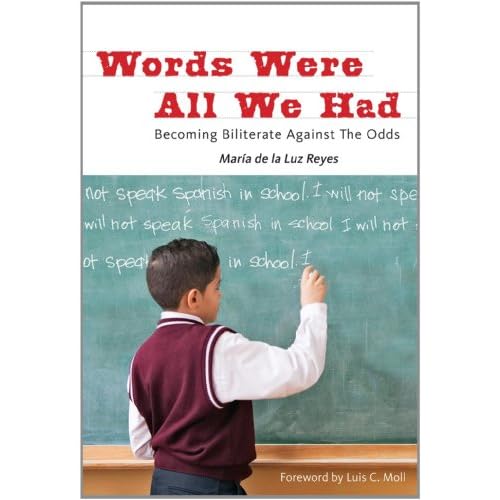
Words Were All We Had: Becoming Biliterate Against the Odds 
(Language and Literacy Series)
[Paperback]Teachers College Press (March 25, 2011)
ISBN-10: 0807751804 ISBN-13: 978-0807751800
Maria de la Luz Reyes

''In this wonderful volume you are about to read elegantly crafted, heartfelt, and insightful autobiographical narratives. They both moved me and instructed me, as few writings have in our field of study.'' --From the Foreword by Luis C. Moll, University of Arizona
 
''The stories included in this collection reflect in extraordinary ways the importance of bilingualism and biliteracy for Latino children.'' --Guadalupe Valdés, Bonnie Katz Tenenbaum Professor of Education, Stanford University 

This engaging collection examines the personal narratives of a select group of well-respected educators who attained biliteracy when they were young students, and in the era before bilingual education. 

These autobiographical accounts celebrate and make visible a linguistic potential that has been largely ignored in schools--the inextricable and emotional ties that Latinos have to Spanish. 

The authors offer teachers important lessons about the individual potential of their Latino students. These stories of tenacity and resilience offer hope for a new generation of bilingual learners who are too often forced to choose between English and their native language.


The Book of Want: A Novel 
[Paperback]
University of Arizona Press (March 1, 2011)
ISBN-10: 0816528993
ISBN-13: 978-0816528998
Daniel A. Olivas

"To read this sensuous and open-hearted novel is to enter a kind of heaven." --Michael Nava, author of The Little Death

"These haunting, lyrical tales, woven into a seamless novel by Daniel A. Olivas, rise from the heart of his beloved Los Angeles, in that mythical place called the Borderlands, and lead the way in a new genre of superb American literature." --Himilce Novas, author of Mangos, Bananas and Coconuts: A Cuban Love Story

"Daniel Olivas has been steadily developing into one of the primary voices of Latino literature's new wave. The Book of Want is a major step forward in his art, a moving, vital narrative from a major American talent." --Luis Alberto Urrea, author of The Hummingbird's Daughter


Rethinking Chicana/ O and Latina/ O Popular Culture
[Paperback]Palgrave Macmillan (March 30, 2011)
ISBN-10: 0230616054 ISBN-13: 978-0230616059
Daniel Enrique Perez

In this book, Daniel Enrique Pérez examines the various ways queer identities are represented in Chicana/o and Latina/o cultural texts. 

Through a gender, ethnicity, and sexuality lens, he demonstrates that queer Chicana/o and Latina/o identities are much more prevalent in cultural production than most people think. 

He argues that the representation of queer identities goes well beyond gay Chicana/o and Latina/o stereotypes: maricones, jotos, and marimachas. Macho men, the Latin lover, Pocho, Real Women Have Curves, Selena, and several other characters and texts are also queer. 

By claiming such a variety of characters and texts as queer, he erases that infamous forward slash that tends to be drawn between the terms straight and gay while expanding the breadth of queer representation in cultural production.


Fit to Be Tied: Sterilization and Reproductive Rights in America, 1950-1980 
(Critical Issues in Health and Medicine) [Paperback]Rutgers University Press; Revised edition (February 11, 2011)
ISBN-10: 081354999X ISBN-13: 978-0813549996
Rebecca M. Kluchin

The 1960s revolutionized American contraceptive practice. Diaphragms, jellies, and condoms with high failure rates gave way to newer choices of the Pill, IUD, and sterilization. 

Fit to Be Tied provides a history of sterilization and what would prove to become, at once, socially divisive and a popular form of birth control. 

During the first half of the twentieth century, sterilization (tubal ligation and vasectomy) was a tool of eugenics. Individuals who endorsed crude notions of biological determinism sought to control the reproductive decisions of women they considered "unfit" by nature of race or class, and used surgery to do so. 

Incorporating first-person narratives, court cases, and official records, Rebecca M. Kluchin examines the evolution of forced sterilization of poor women, especially women of color, in the second half of the century and contrasts it with demands for contraceptive sterilization made by white women and men. 

She chronicles public acceptance during an era of reproductive and sexual freedom, and the subsequent replacement of the eugenics movement with "neo-eugenic" standards that continued to influence American medical practice, family planning, public policy, and popular sentiment.


Mexican Voices of the Border Region: Mexicans and Mexican Americans Speak about Living along the Wall 
(Voices Of Latin American Life)
[Paperback]Temple University Press (March 18, 2011)
ISBN-10: 1592139094 ISBN-13: 978-1592139095
Laura Velasco Ortiz (Author), Oscar F. Contreras (Author), Sandra del Castillo (Translator) 

Every day, 40,000 commuters cross the U.S.-Mexico border at Tijuana-San Diego to go to work. 

Untold numbers cross illegally. Since NAFTA was signed into law, the border has become a greater obstacle for people moving between countries. Transnational powers have exerted greater control over the flow of goods, services, information, and people. 

Mexican Voices of the Border Region examines the flow of people, commercial traffic, and the development of relationships across this border. Through first-person narratives, Laura Velasco Ortiz and Oscar F. Contreras show that since NAFTA, Tijuana has become a dynamic and significant place for both nations in terms of jobs and residents. 

The authors emphasize that the border itself has different meanings whether one crosses it frequently or not at all. The interviews probe into matters of race, class, gender, ethnicity, place, violence, and political economy as well as the individual's sense of agency. 


Making the Mexican Diabetic: Race, Science, and the Genetics of Inequality
[Paperback]University of California Press; 1 edition (March 18, 2011)
ISBN-10: 0520267311 ISBN-13: 978-0520267312
Michael Montoya 

This innovative ethnographic study animates the racial politics that underlie genomic research into type 2 diabetes, one of the most widespread chronic diseases and one that affects ethnic groups disproportionately.

Michael J. Montoya follows blood donations from "Mexican-American" donors to laboratories that are searching out genetic contributions to diabetes. His analysis lays bare the politics and ethics of the research process, addressing the implicit contradiction of undertaking genetic research that reinscribes race's importance even as it is being demonstrated to have little scientific validity. 

In placing DNA sampling, processing, data set sharing, and carefully crafted science into a broader social context, Making the Mexican Diabetic underscores the implications of geneticizing disease while illuminating the significance of type 2 diabetes research in American life. 


Born to Run: A Hidden Tribe, Superathletes, and the Greatest Race the World Has Never Seen  
(Vintage) [Paperback]
Christopher McDougall 

Full of incredible characters, amazing athletic achievements, cutting-edge science, and, most of all, pure inspiration, Born to Run is an epic adventure that began with one simple question: Why does my foot hurt? In search of an answer, Christopher McDougall sets off to find a tribe of the world’s greatest distance runners and learn their secrets, and in the process shows us that everything we thought we knew about running is wrong.

Isolated by the most savage terrain in North America, the reclusive Tarahumara Indians of Mexico’s deadly Copper Canyons are custodians of a lost art. 

For centuries they have practiced techniques that allow them to run hundreds of miles without rest and chase down anything from a deer to an Olympic marathoner while enjoying every mile of it. 

Their superhuman talent is matched by uncanny health and serenity, leaving the Tarahumara immune to the diseases and strife that plague modern existence. 

With the help of Caballo Blanco, a mysterious loner who lives among the tribe, the author was able not only to uncover the secrets of the Tarahumara but also to find his own inner ultra-athlete, as he trained for the challenge of a lifetime: a fifty-mile race through the heart of Tarahumara country pitting the tribe against an odd band of Americans, including a star ultramarathoner, a beautiful young surfer, and a barefoot wonder.

With a sharp wit and wild exuberance, McDougall takes us from the high-tech science labs at Harvard to the sun-baked valleys and freezing peaks across North America, where ever-growing numbers of ultrarunners are pushing their bodies to the limit, and, finally, to the climactic race in the Copper Canyons.  

Born to Run is that rare book that will not only engage your mind but inspire your body when you realize that the secret to happiness is right at your feet, and that you, indeed all of us, were born to run.


What Can't Wait 
(Carolrhoda Ya) [Hardcover]
Carolrhoda Books (March 2011)
ISBN-10: 0761361553 ISBN-13: 978-0761361558
Ashley Hope Perez

"Another day finished, gracias a Dios." Seventeen-year-old Marisa's mother has been saying this for as long as Marisa can remember. Her parents came to Houston from Mexico. They work hard, and they expect Marisa to help her familia. An ordinary life--marrying a neighborhood guy, working, having babies--ought to be good enough for her. 

Marisa hears something else from her calc teacher. She should study harder, ace the AP test, and get into engineering school in Austin. Some days, it all seems possible. On others, she's not even sure what she wants. When her life at home becomes unbearable, Marisa seeks comfort elsewhere--and suddenly neither her best friend nor boyfriend can get through to her. Caught between the expectations of two different worlds, Marisa isn't sure what she wants--other than a life where she doesn't end each day thanking God it's over. But some things just can't wait...


Bookmark and Share

Monday, March 07, 2011

The Chicano Movement: Some Not Too Objective Observations on The Movement's Goals


The Chicano Movement: Some Not Too Objective Observations


 Goals

by Abelardo B. Delgado
The goals of the Chicano Movement are various and most of them are justifiable – in El Paso, decent housing; in Denver, community control; in California, educational opportunities; in Tierra Amarilla, land; and in El Valle de Tejas, economic survival; in San Antonio, political justice. 

The over-all refusal to serve in a war that serves only to eliminate our youth. In the college scene, admittance, Chicano Studies, and administrative positions; in the courts, a voice; in the jails and hospitals, a recognition of La Raza and what makes us so vividly different.

What is important in discussing goals, is to view them objectively and to determine first of all, if they are feasible, and secondly, to determine if they are justifiable. 

It is here that the movement and its goals become disproportionately comical in that there are at least two million Chicanos who cannot be acknowledged in any social status in this country. For these Chicanos, it is reasonable to have as an objective, the basic necessities for living – food, clothing, medication, shelter, furniture, employment, and a basic education. 

For these Chicanos, the movement is sometimes a mirage with which they cannot truly identify, as most of us (in the movement) are so involved in fighting the racism and cultural ghost that we forget that the real movement is to get these carnales liberated from the misery in which they live.

A primary goal of the movement is that of abolishing the extreme poverty under which the majority of the huge population of Chicanos live. It is because this goal is so sacred that we put our emphasis on the barrio and the leader who struggles there. These people are well below the perimeter where the war on poverty is taking place. In fact, these people are oftentimes looked down on by us, their own.

Many of us still mistake goals in terms of range and importance and foolishly claim to derive a quick solution for a previous century of deprivation. 

Yes, if we pay a man a decent wage, he can take care of his needs, if we provide a home, if we help him attain a G.E.D., if we help him through college, if we provide job training, if we make him a U.S. Citizen, if we organize him, if we teach him to speak English, and on and on, we go drafting solutions; if we can register him so he may vote, if we put him in business, if, if, if, and we ignore the fact that the movement is a combination of making all those possible. 

Better yet, the movement is shaking and waking up one another in the hope that we might realize the state we are in, and decide to shed both the real and the imaginary shackles that have us where we are and prevent us from saying the beautiful words – Ya Basta – the rest is easy.

Truly, one of the most promising goals of the Chicano Movement is the salvaging of the youth so that they can, at least, be free of the burdens we have endured. 

But here and now is where the movement turns into a “gallinero” with all the chickens plucking grain wherever they can. Instead of an intelligent working plan, which can give the Chicano movement the input it needs, we continue to shadow box. 

Yes, goals we can agree on without much hassle, but as far as the means of reaching them and the speed with which we may reach them are subjects open to debate, even among ourselves.

Bookmark and Share

Other parts of this series:

Part IV Goals 
 
from The Chicano Movement: Some Not Too Objective Observations by Abelardo B. Delgado, (Denver: Colorado Migrant Council, 1971), prepared by the Colorado Migrant Council. Published with permission from the Delgado Family. Special thanks for Dolores Delgado. (c) Abelardo Delgado 1971, all right reserved. This may not be republished with out the permission of the Delgado estate.


El Paso Writers Update for the Week of March 6, Part I


Share


Texas finances and Education: It Goes on

Raymund Paredes was quoted on a Austin-American Statesman regarding Scott Hochberg Hochberg, chairman of the Texas House appropriations subcommittee on education. In Texas' ever growing initiative to cut off higher education funding to people of color and the poor, Paredes is quoted. READ MORE. Also see "Raymund Paredes: Why TEXAS Grants should factor in academic performance."


Zeta Acosta, Hunter S. Thompson: Lost Interview

Oscar Zeta Acosta is mentioned an article by Ian Johnston on Hunter S. Thompson about an unpublished interview with Thompson. (The Quetus). READ MORE. Also, check out The Generalist Blog for a good post on Acosta: "The story goes as follows. Oscar Zeta Acosta was the model for the attorney in ‘Fear and Loathing in Las Vegas’, portrayed in the two movie versions of the story by Peter Boyle an"d Benito del Toro." READ MORE.

Above left, Sal Castro, right Mario T. Garcia


Mario T. Garcia visits the hometown

Mario T. Garcia was in town for the Texas Historical Association conference. He did two presentation at New Mexico State University and UT El Paso on his book
"Blowout! Sal Castro and the Chicano Struggle for Educational Justice" (The University of North Carolina Press, $34.95) by Castro and Mario T. García. Check out Dennis Bixler-Marquez' review in the El Paso Times: "Pivotal protests: New history provides important documentation of L.A. student walkouts."

Review Pop Up: Ray Gonzalez and Pat Mora

A few dated review have popped up on Publsihers Weekly. See a review of Ray Gonzalez The Hawk Temple at Tierra Grande and Pat Mora's This Big Sky.  

MySpace, your Space

There is a MySpace page for Claudia Guadalupe Martinez. Check it out.

Ilan Stavans


Stavans and Morton on Oscar Zeta Acosta and "Zeta"

A neat article on Carlos Morton and Ilan Stavan's and their play "Zeta" on The Wicked Local: "Ghost of Oscar Acosta zones in at Wellfleet Harbor Actors Theater": "The play “Zeta” is the result of a chance conversation Stavans had with Carlos Morton, a prominent Mexican-American playwright, when they ran into each other in California a few years ago. Morton encouraged Stavans to follow his dream to write a play about Acosta, and Stavans asked Morton to collaborate. That conversation led to an early draft, and the two playwrights discovered they worked well together." READ MORE.

Pat Mora on Youtube.com

There is a little post on Pat Mora including a video about how she came to be a children's writer. READ MORE.

A Facebook Group has been created for Luis J. Rodriguez' La Vida Loca. Check it out.


Report on Ruben Salazar's death released


Solis at New Play Summit

Octavio Solis participated in the recent New Play Summit in Denver. See "Moore: Summit play revels in Denver's yellow past."

City of Night

Need a first-edition copy of City of Night (condition unknown). Check out this auction on EBay.uk

Pat Mora to be in Tucson in April

Pat Mora will join ALSC in Tucson, Ariz. on Sautrday, April 30, 2011 to celebrate the 15th anniversary of El día de los niños/El día de los libros (Children’s Day/Book Day), also known as Día. The event will take place at the Valencia Branch of the Pima County Library System from 11:30 – 3 p.m. READ MORE.

Interview with Albino Carrillo and others

Albino Carillo is quoted along with other poets in a a Poets Society of America roundtable. Check it out.


Bookmark and Share

Wednesday, March 02, 2011

John Boehner: Demands Drastic Measures Now that Cd. Juarez is in the United States


House Speaker Demands Drastic Measures Now that Cd. Juarez is in the United States
Cd. Juarez now Westernmost Part of Texas Says Texas Gov. Perry

by Jesu Sita
Washington Pest Staff Writer
Tuesday, March 1, 2011; 10:04 AM
Share

House Speaker John Boehner held a press conference this morning calling on the Obama administration to take drastic measures now that Cd. Juárez, Mex., according to Texas Gov. Rick Perry, is now in the United States.


Monday, Gov. Perry, following Texas tradition of taking land from Mexico, announced that Cd. Juárez , Chihuahua was the “most dangerous city in America.”


“We were really surprised,” said Mexican President Felipe Calderon, who just last week called President Obama on Feb. 23 to sing him the revolutionary corridoLa Persecución de Villa” which Mexican presidents are constitutionally required to do every Feb. 23. (Clerk here, for live recording of Felipe Calderon singing "Nuestro Mexico febrero 23".)


“I had just finish singing 'gringos tan patones' part,” says Calderon, “and bah, I heard Cd. Juárez was now in the United States. We are more accustomed to the United States invading our country and taking our land -- Perry caught us off guard.”


Texas Gov. Rick Perry celebrates the recent annexation of Mexican territory


Both Mexicans and United States citizens were surprised at the news that nearly 2 million Chihuahuenses were now Texans.


“Yo soy de mero ChiTejas...chingao this is too confusing,” say L. Gato D. Chihuahua of the Felipe Angeles colonia in Cd. Juárez, “it just doesn't sound right.”


Cici Puede who teaches Chicano Studies at the University of Texas at El Paso was more alarmed about how easily the United States took Cd. Juarez.


“We are used to a smorgasbord of gabacho tactics when it comes to stealing land,” says Puede, “but nowadays, it's just becoming far too easy, a simple press conference or redevelopment plan y ya.”


Puede refers to various action by states and gringo elites to deny Mexicans United States citizenship and land. This was land that the Mexicans owned after the U.S.-Mexico War and the Treaty of Guadalupe Hidalgo that followed.


For example, contrary to the treaty, California voted that Mexicans were not U.S. citizens because “further action by Congress” was needed to make them citizens, therefore they could not own land.


Also, Native Americans who lived in parts of the U.S. that once was Mexico were considered Mexican citizens before the U.S.-Mexico War. However, the U.S., once it conquered the land, did not grant citizenship to Native Americans.


Leonard Owldog, professor of Native American Studies at Arizona State University also was astonished at Perry's actions.


“These guys usually take land and commit genocide in the process,” says Owldog, “then they name their state, county, city, or football team in honor of the Indians they forced out or killed.” “They like to name land after us,” says Owldog, “as long as we are not on it any more.”


However, New Mexico governor Susana Martínez, who this past weekend was turning over her undocumented family members to Immigration and Customs Enforcement, was not amused by Perry's actions.


“This gives the U.S. another 2 million people for me racially profile and deport,” says Martínez. “Dividing families is hard work.”


Martínez also stated that New Mexico was keeping an eye on Texas since Texas has twice tried to make New Mexico part of Texas. “If they tried to do it before,” says Martínez, “they'll try again.” 

“New Mexico is tired,” said Martínez, “of Texans coming to New Mexico acting like native New Mexicans and trying to run our state.”


"New Mexicans are tired of Texans trying to run our state," says NM Gov. Susana Martinez at a Wed. morning press conf.


“New Mexico has experience with Mexicans who are new to the United States,” says Martínez. “After the U.S.-Mexico War,” continued Martínez, “Hispanos, when creating the New Mexico Territory restricted U.S. citizenship to 'free white male inhabitants residing within the limits of the US but who [were residents] on the 2nd day of Feb. 1848.'”


In using the term “Hispanos” Martinez refers to New Mexicans who believe they are of pure Spanish blood and in fact White.


Historians say that later, when the U.S. Supreme Court looked at this New Mexican law for former Mexican citizens acquiring citizenship, it ruled that since New Mexico was a territory and not a state at the time, the former Mexican citizens could not become U.S. citizens.


It remains to be seen if these 2 million new inhabitants of the United States will be treated the same way.


Meanwhile, the El Paso del Norte Group, an elite business association in El Paso is eying land in Cd. Juárez with hunger. Rob A. Sutierra, president of the group, says they are reviewing various gabacho tactics to take juarense land.


“There are many things we can do,” says Sutierra. “Make the process for the juarenses to prove title to their land bureaucratic, take advantage of imperfect titles, burn the records office down, make them prove the title in courts that are100 miles away, make it terribly expensive to defend your land's title in court, make filing fee high, write redevelopment plans with no input from the community or the poor resident, reclassifying the land as 'blighted', or using non-profits to do our dirty work.”


As Customs and Border Patrol extended their patrols to the southern city limits of Cd. Juárez, Texas today, thousand rushed the former international bridge.

juarense school children realizing they are now texans


El Pasoan Jose Tiralon quickly took advantage and cross the bridge to refill his contacts prescription. “This is sweet, no more lines when I need new contacts – a verdad!” Meanwhile, Texas governor Perry, so elated that he could take Mexican territory with no invasion, he performed un baile de carquís.


Bookmark and Share

Tuesday, March 01, 2011

Lunes con Lalo: Some Not to Objective Observations on the Chicano Mov't and the Cultural Revolution


Lunes con Lalo
The Chicano Movement: Some Not Too Objective Observations


Cultural Revolution

by Abelardo B. Delgado
Let me begin this chapter by quoting from a letter I have received from Tiger (Reymundo Perez) from Syracuse, New York. I read the letter in Denver, and was moved by the expression of this poet carnal. He was found carrying a gun and was booked. 

Reymundo "Tigre" Perez
 Excessive bail was placed on him because his name was also in the list of subversive Americans. But the meat of his letter was that he was found carrying a book of his poems, Free, Free at Last. He fears his book will also be tried with him. 

We are butting out a book called Los Cuatro in which Tiger is one of the four poets. He wanted us to remove his poems for fear of jeopardizing the efforts of the other three. 

My answer was: “bull shit!” 

We write what we want in prose or in poetry. We were so long without a word in this country. Now the written word comes out like machine gun bursts.

And so, the cultural awakening that has come about through the Movement has released the “almas gigantes” to materialistic world in which they were not only held captive, but incominicado. 

Now you see El Teatro Campesino and now your see galleries of the scope of the one in the Cruzada para la Justicia in Denver; and now you see poets like Alurista debating about where to go since so many colleges crave for him. Now you see shows worthy of prime time on T.V. Such as the one presented in Denver on September 16th. The music, movement song, poems – angry and gentle, the canvas magically painted yells at the passerby and tells the story of oppression, gallantly confronted by millions of Chicanos.

The Chicano hand has not lost its gift and he chisels and he molds away a mystic beauty. The eye still captures the contrasting serenity existing deep inside Chicanos. 

The novelist, the trio, the conjunto, all add their trademark to their work. What is of even more importance, is a sincere desire to share the talents with the barrio and the campesinos and in the snobbish action tell the elite to screw themselves. 

Let the snobs continue listening to their soundless music, see their empty canvases, and read their computerized poetry, because what we create is for our Raza first, and we feel some will be left over for the critic, the socialite, the academician and for Madison Avenue.

This is the key happening in the world of arts, ancient and revived by us Chicanos, and we feel that it is another way of saying “Ya basta.” Through the school systems you, dominant snobs that you have always been, decided for us that what was good, what poems were good, and even in our language; made us look beyond our own greatness, unto the Spanish for association. 

It was not a total failure on your part, for many Chicanos claim to dig seguidillos or coplas, instead of corridos and boleros; and they go ape to hear Lorca or Cervantes, but ignore the giants to the South, to Mexico; and the giants in our own country such as Cleofas Vigil and Ricardo Sánchez.


The cultural revolution alone is worth the many sacrifices endured, such as the one where Tiger's poetry will label him a radical communist. It is no wonder that a couple of lines from the poem, “Stupid America” express the despair within us --- “He will die with a thousand masterpieces – hanging only in his mind.” 

The artistic and poetic heart of Chicanos, Puerto Ricans, Cubans, and Latins in general, is essential to the survival of the affluent Americans, and to the destruction of their materialistic stupor.

Other parts of this series:

Part IV Goals 
 
from The Chicano Movement: Some Not Too Objective Observations by Abelardo B. Delgado, (Denver: Colorado Migrant Council, 1971), prepared by the Colorado Migrant Council. Published with permission from the Delgado Family. Special thanks for Dolores Delgado. (c) Abelardo Delgado 1971, all right reserved. This may not be republished with out the permission of the Delgado estate.


Bookmark and Share