"Chicano writers from El Paso are the most progressive, open-minded, far-reaching, and inclusive writers of them all."

Octavio Romano

Sunday, July 04, 2010

Sunday Small Press Spotlight: Coffee House Press -- El Paso Writer Updates: David Romo, C.M. Mayo, Javier Huerta, Pat Mora, Pura Belpré Medal awards, Conway Twitty


Sunday Small Press Spotlight

Housekeeping: You can subscribe to the Pluma Fronteriza blog to the left of the screen and get new posts as they are posted. You can also become a "Follower" by clicking "Follow" at the upper left of the screen.

Coffee House Press

Coffee House Press (www.coffeehousepress.org)is a small press out of Minneapolis, MN that has existed since 1984. They named themselves Coffee House due to the use of coffee houses as forums: "The English coffee house of the 1600s was a place of fellowship and discussion of the events of the day. The Parisian cafes of the early 1900s witnessed the birth of Dadaism, cubism, and surrealism. The American coffee house of the 1950s, a refuge from conformity for beat poets, exploded with literary energy. This spirit lives on in the pages of Coffee House Press books."

Currently, they are not accepting book submissions, but they tell us: "Coffee House Press publishes emerging and mid-career authors. Nearly all CHP authors have had works published in literary magazines or other publications: a resume including a list of prior publications can publications can strengthen your submission."

Coffee House Press publishes literary novels, full-length short story collections, poetry, and essays. CHP does not accept submissions for our anthologies. CHP also does not publish genre fiction such as mysteries, Gothic romances, Westerns, science fiction, or books for children.

Coffee House is the publishers of Aaron Michael Morales new book Drowning Tucson. Good books to continue the tradition of Lalo Guerrero and Mario Suarez.


Drowning Tucson
Novel by Aaron Michael Morales

Publisher's Description: Set in Tucson's toughest neighborhoods during the late 1980s, this explosive novel follows the disintegration of the Nuñez family and the people whose paths they cross. From young gang members to crooken cops, and from murderous vigilantes to prostitutes plying their trade along the “Miracle Mile,” each character's destiny is linked by crushing poverty, the brutal codes of the street, and the harsh nature of the desert. In this place of both drought and flood, “civilization” is every bit as dangerous as its surroundings. 

It has some good blurps:
Luis Alberto Urrea:
“Morales wrestles with nothing less than the parameters of the human soul.” 

Leslie Marmon Silko:
“You will not forget Drowning Tucson. The characters will haunt you, and even after you know the stories are getting to you, you won't be able to stop reading this book.” 

Benjamin Alire Sáenz:
“This novel will not make you feel good. It will make you want to avert your eyes in the same way Richard Wright made you want to avert your eyes in Native Son. I am in awe of the muscular writing here, writing that is brave, honest, precise, and disciplined. Drowning Tucson took my breath away.” 


Autopsy of an Engine 
(Coffee House Press ISBN: 1-56689-1612)
Lolita Hernández. 

This native Detroiter is for all readers interested in leaning about life and death. The stories are poignant and powerful. She has survived the boredom of factory work and working on the line. Detroit was my home during the turmoil of plant closings; Autopsy of an Engine helped me to appreciate better the lives of the factory workers that surrounded me on the busses and community.

Lolita gives us the autopsy of an engine with incredible detail. The reader will find themselves right there standing on the pallet, looking for the three legged rat distracted by the heavy sounds of machinery, or standing there with a handful of Abbie’s pound cake and hot coffee. Her genius as a writer can be added to the list of other factory writers, Josie Kearns, Sue Little, Jim Daniels, Leon Chamberlain who have focused on "the life of the factory workers’ in their writings.
Some might say these are the stories of the voiceless, but they are not voiceless, sometimes those of us who drive Cadillacs, Buicks, Fords, are just unwilling to take the time to listen to them or in this case read about them.

In Autopsy of an Engine, Lolita shares with us the demise of the workplace that was her life for over 31 years at GM and 21 of those at the Cadillac plant. Her genius as storyteller and her ability of conveying the pain, the boredom, the sadness, the moments that bring a smile to the fellow workers. Her writing is strong and hard like life on the line, and we are reminded that there is life after death and the Autopsy! She relates the lives of her co-workers in a style that makes it difficult to put the book down. – Trinidad Sánchez, Jr. author of Why Am I So Brown? www.coffeehousepress.org

Cantos to Blood and Honey
Coffee House Press (1997)ISBN-10: 1566890675

A rhythmic debut poetry collection powered by the pulse of the Caribbean, Cantos to Blood & Honey presents a synthesis of Afro-Caribbean, Hispanic, and North American mythology, language, and aesthetics.  Adrian Castro, an Afro-Latino performance poet, explores within this dance issues of migration, cultural continuity, memory, and history.  Virgil Suárez, author of Spared Angola, says "Cantos to Blood & Honey is a celebration—a celebration of a lively, original, and mesmerizing new voice who is destined to burn a path through the contemporary American poetry scene.  If we read and listen, we will be taken over by this fine poet in a knockout and lasting debut." READ MORE.


EL PASO WRITER UPDATE

David Romo and Border Violence


David Romo, author of Ringside Seat to Revolution was featured on the Texas Tribune Website. You can hear a download of his commentary by clicking here: Historian Talks Violence on El Paso/Juarez Border.


London Ale with Luis Rodriguez

Luis has been blogging from England and posted a new post "Jet Lag Notes" yesterday.


Abuelos de Pat Mora

The dkhpoetryandliteratureforfun blog posted a review of Pat Mora's children's book Abuelos. "This is a very pleasant picture book about a brother and sister discovering a part of their cultural heritage, "An old New Mexican tradition-'los abuelos." Read more.


Guest Blogging: There's More to it says C.M. Mayo

C.M. Mayo, in a guest blog on Christina Baker Kline's blog, gives her advice on "Guest blogging" for writers. "Many long-established writers are newly busy with guest-blogging--- and hosting guest-bloggers," says C.M. Mayo, "...guest-blogging is at once a flourishing new literary genre and a powerful tool for literary promotion." READ MORE.

 Other news

The Texas Tribute posted a profile of Raymund Paredes. See it by clicking this link: http://www.texastribune.org/texas-people/raymund-paredes/

Javier Huerta will be performing with other writers at


In Solidarity: West Coast Kundiman Poetry Reading, Part 3
Sunday July 11
3:00 PM
Eastwind Books of Berkeley

2066 University Avenue, between Milvia St and Shattuck Ave
Berkeley, CA

Huerta is the author of Some Clarifications y otros poemas

This reading is a fundraiser for Kundiman, a non-profit organization
that fosters emerging Asian American poets with an annual poetry
retreat. We are raising funds for a Kundiman West Coast Scholarship
Fund, which would support one Kundiman fellow from the West Coast to
attend the retreat for free, as well as a community activist/poet. So
far, we have raised $90.00 and hope to raise the full $300.00 by the
end of summer.
http://www.kundiman.org/
http://www.kundiman.org/fellows/

======================

Pura Belpré Medal awards

For Immediate Release
Tue, 06/15/2010 - 20:28
Contact: Macey Morales
Public Information Office (PIO)

Recipients of prestigious Pura Belpré Medal accept awards, sign winning books
CHICAGO – Hundreds will gather for an event that celebrates the most influential Latino authors and illustrators of children’s literature.  The Pura Belpré Celebración will serve as a national backdrop for the presentation of the coveted Pura Belpré Medal, an award that recognizes Latino authors and illustrators of children’s literature. The event, open to registered conference-goers, will take place from 1:30 – 3:30 p.m. on Sunday, June 27, 2010 at the Mayflower Renaissance Hotel/East State Ballrooms, during the American Library Association (ALA) Annual conference taking place from June 24 to June 29 in Washington, D.C.

Given annually, the Pura Belpré Medal is awarded to a Latino writer and illustrator whose work best portrays, affirms and celebrates the Latino cultural experience in an outstanding work of literature for children and youth. The award is known worldwide for the high quality it represents and serves as a guideline for educators, parents and bookstores for the best of the best in Latino-themed children’s literature.

The event will honor the following 2010 Belpré Medal winners and honorees:
  • Julia Alvarez, author of “Return to Sender,” published by Alfred A. Knopf, an imprint of Random House Children’s Books.
  • Rafael López, illustrator of “Book Fiesta!: Celebrate Children’s Day/Book Day; Celebremos El día de los niños/El día de los libros,” written by Pat Mora and published by Rayo, an imprint of HarperCollins Publishers.
  • Carmen T. Bernier-Grand and David Diaz, author and illustrator of “Diego: Bigger Than Life,” published by Marshall Cavendish Children.
  • Georgina Lázaro, author of “Federico Garcia Lorca,” illustrated by Enrique S. Moreiro and published by Lectorum Publications Inc., a subsidiary of Scholastic Inc.
  • Yuyi Morales, illustrator of “My Abuelita,” written by Tony Johnston and published by Harcourt Children’s Books, Houghton Mifflin Harcourt.
  • John Parra, illustrator of “Gracias. Thanks,” written by Pat Mora and published by Lee & Low Books Inc.
Event highlights include a performance by Los Quetzales Mexican Dance Ensemble under the direction of Laura Ortiz. Participating authors will sign copies of their award-winning books.

The Pura Belpré Medal is named in honor of Pura Belpré, the first Latina librarian from the New York Public Library. As a children’s librarian, storyteller and author, she enriched the lives of Latino children through her pioneering work of preserving and disseminating Puerto Rican folklore. The award is given by the Association for Library Service to Children (ALSC), a division of the American Library Association (ALA), and co-sponsored by the National Association to Promote Library and Information Services to Latinos and the Spanish-Speaking (REFORMA).

For more information regarding the Pura Belpré Medal please visit http://tinyurl.com/Belprémedal.

ALSC is the world’s largest organization dedicated to the support and enhancement of library service to children.  With a network of more than 4,200 children’s and youth librarians, literature experts, publishers and educational faculty, ALSC is committed to creating a better future for children through libraries.  To learn more about ALSC, visit their Web site at www.ala.org/alsc.
Founded in 1971, REFORMA is committed to promoting the development of library collections that include Spanish language and Latino oriented collections; advocating for library services and programs that meet the needs of the Latino community; educating the Latino population of the availability of library resources; and the recruitment of bilingual and bicultural library professionals and support staff. For more information on REFORMA, visit www.reforma.org.
-30-

 =======================================================================

The link we share with you today is:

conway twitty - hello darling 

Bookmark and Share

Saturday, July 03, 2010

New Books in July 2010 - 1970 Retrospetive: Richard Vazquez, Los cuatro, Raymundo Tigre Perez, Luis Omar Salinas


NEW BOOKS IN JULY 2010

(Lyons Press July 1, 2010 ISBN-10: 1599218615)
Terry Greene Sterling

Arizona’s violent border is the busiest gateway for illegal immigration in America, making Arizona Ground Zero for the immigration debate. No state is as hostile to the undocumented, and no city is as unwelcoming as Phoenix. 

Yet Phoenix is home to thousands who live in the shadows, where civil rights are neglected and lives are lost. Illegal sheds light on the invisible immigrants who persevere despite kidnappings and drug wars, an ongoing recession, and laws barring them from working, learning, and driving. By profiling these undocumented people, and those — like notorious Sheriff Joe Arpaio — who persecute them, author Terry Greene Sterling courageously reveals the changing face of immigration in America and gives new insight into a divisive national crisis.


Nation Books; 1St Edition edition  
ISBN-10: 156858449
Charles Bowde

Ciudad Juárez lies just across the Rio Grande from El Paso, Texas. A once-thriving border town, it now resembles a failed state. Infamously known as the place where women disappear, its murder rate exceeds that of Baghdad. Last year 1,607 people were killed — a number that is on pace to increase in 2009. 

In Murder City, Charles Bowden — one of the few journalists who has spent extended periods of time in Juárez — has written an extraordinary account of what happens when a city disintegrates. Interweaving stories of its inhabitants — a raped beauty queen, a repentant hitman, a journalist fleeing for his life — with a broader meditation on the town’s descent into anarchy, Bowden reveals how Juárez’s culture of violence will not only worsen, but inevitably spread north. 

Heartbreaking, disturbing, and unforgettable, Murder City establishes Bowden as one of our leading writers working at the height of his powers.


(Counterpoints: Studies in the Postmodern Theory of Education)(Peter Lang Publishing; First printing edition July 15, 2010 ISBN-10: 1433106108)

Regina Bernard-Carreño


The theory of Nuyorganics joins Nuyorican poetry to organic intellectualism. Examining its possibilities, this book questions existing theories of the dominant elite and offers new theories for those who struggle for accurate representation in their academic environments. 

It shows the importance of understanding that lived experiences are often undiscovered sources of expertise and untapped resources for both teachers and students in classrooms of higher education. Drawing attention to new ways of thinking, this book is a voice for those who have fought for a rigorous, socially just education to be the primary goal of any academic training.


(A Quinceañera Club Novel)
(Grand Central Publishing July 20, 2010 ISBN-10: 0446540528)
Belinda Acosta

Beatriz Sánchez-Milligan is shocked when her 14-year-old niece, Celeste, stumbles into her 25th wedding anniversary party. Celeste reveals that her mother, Perla, has died and that she has nowhere else to go. Beatriz immediately takes Celeste in-a decision that troubles her husband, Larry, who remembers that wherever Perla went, trouble followed. He worries his wife is rushing in without having all the facts.

Undaunted, Beatriz begins to plan a quinceañera for Celeste; but the party planning doesn't comfort Celeste, nor does it ease Beatriz's pain. She feels guilty for losing contact with Perla, and that guilt grows deeper when she meets Josie Mendoza, a journalist who reveals that Perla may have been murdered. Beatriz wants to adopt Celeste to make peace with her late sister, but Larry still has concerns. For the first time, their rock solid marriage starts to crumble, and a frightened, young girl is caught in the middle. Somehow Beatriz must find a way to save her family, before the ghosts of her past tear it apart.


(Rowman & Littlefield Publishers, Inc. July 16, 2010 ISBN-10: 0742556603)
James M. Cypher.

Written by two leading scholars, this book provides a detailed analysis of Mexico's political economy. James M. Cypher and Raol Delgado Wise begin with an examination of Mexico's pivotal crisis of the 1980s and the consequent turn toward an export-led economy, later anchored by NAFTA. 

They show how Mexico, after abandoning frequently successful past practices of state-led development, disastrously tied its future to an unconditional reliance on foreign corporations to promote an export-led growth strategy. This strategy, they convincingly argue, has resulted in a fragmented economy marked by stagnation, falling wages, informal part-time employment, and massive migration, which define daily life for all but a tiny minority.

(Dialogos Series)
(University of New Mexico Press July 16, 2010 ISBN-10: 0826344933)
Ida Altman

"The War for Mexico's West" examines a dramatic, complex episode in the early history of New Spain that stands as an instructive counterpoint to the much more familiar, triumphalist narrative of Spanish daring, resilience and victory embodied in the oft-told tale of the conquest of central Mexico.

As Spaniards consolidated their hold over central Mexico they fanned out in several directions, first entering western Mexico - the future New Galicia - in 1524. A full-fledged expedition of conquest followed several years later.

Among the loosely organized, ethnically and linguistically diverse societies of New Galicia, however, neither the Spaniards' usual stratagems of conquest nor their attempts to settle and impose their institutions met with much success.

An uprising against Spanish rule, today known as the Mixton war, erupted in 1540, attracting thousands of people from many different indigenous communities and bringing Spanish failure in the region into sharp relief.


Set within the context of the complex politics of early New Spain in which such prominent figures as Hernando Cortes, Nuno de Guzman, Pedro de Alvarado, Francisco Vazquez de Coronado and don Antonio de Mendoza vied to fulfill their ambitions in the west and incorporating accounts and testimony reflecting indigenous perspectives, Altman's treatment of the prolonged conquest of New Galicia provides the first full-length account in English of these little-known events and their consequences for Indians and Spaniards.


(Palgrave Macmillan July 20, 2010 ISBN-10: 0230619576 ),
Sharon Bailey Glasco
 
Chicano--Richard Vásquez

This book examines the spatial, material, and cultural dimensions of life in eighteenth-century Mexico City, through programs that colonial leaders created to renovate and reshape urban environments.

In doing so, this study reveals various points of conflict and discord over how various social groups defined and shared the public spaces in the city, and understood their place within a wider colonial system. Bailey Glasco, drawing on research from numerous archives in Mexico City, sheds new light on the critical roles that urban planning and renewal played in the social and cultural dynamics of the city, as well as how it anticipated early definitions of modern Mexican identity. 


RETROSPECTIVE 1970


Richard Vásquez

A bestseller when it was published in 1970 at the height of the Mexican-American civil rights movement, Chicano unfolds the fates and fortunes of the Sandoval family, who flee the chaos and poverty of the Mexican Revolution and begin life anew in the United States.
Patriarch Hector Sandoval works the fields and struggles to provide for his family even as he faces discrimination and injustice. Of his children, only Pete Sandoval is able to create a brighter existence, at least for a time. But when Pete's daughter Mariana falls in love with David, an Anglo student, it sets in motion a clash of cultures.
David refuses to marry Mariana, fearing the reaction of his family and friends. Mariana, pregnant with David's child, is trapped between two worlds and shunned by both because of the man she loves. The complications of their relationship speak volumes -- even today -- about the shifting sands of racial politics in America.

In his foreword, award-winning author Rubén Martínez reflects on the historical significance of Chicano's initial publication and explores how cultural perceptions have changed since the story of the Sandoval family first appeared in print.


Los cuartro, Abelardo Delgado, Ricardo Sánchez, Raymundo “Tigre” Pérez, and Juan Valdez
Barrio Publications 1970


The first anthology of Chicano poetry in Chicano Renaissance Literature.

LOS CUATRO IS a travesty perpetrated in madness and wishful thinking by four ape-like poets in the heat of their own loneliness and need for an articulate explosion that would rock the boat and make amerika take nooootice.

ape #1 is Lalo Delgado, a paunchy carnal with the fire of an Aztec hero and the soft lilting phrases of Cervantes;

ape #2 is Reymundo "Tigre" Pérez, a finely featured chicano with a razor sharp mind trying to dissect amerika;

ape #3 is a fiction called Juan Valdez, but the real man behind that name is Magdaleno Avila--a brute of a man in frame, but a sensitive soul writing his hurts and hopes hoping that the tide will turn and Uncle Sam might be resuscitated, for sam is very much a dead machine chewing up people just for the sake of it; and

ape #4 is an ex-con, Ricardo Sánchez ... with all the attendent hopes, wishes, needs, and hasty plots that never work for an escape from the mendacious frenetic desmadrazgo that society is ... his plans never work, he still continues being very much a social being.

this book then is the culmination of needs meeting up with resource orchestration building up to that cataclysmic crescendo when the world go ker-plunk and presto there shall blossom forth a new social order-- so some think ... still there will be madness, for it is in the human way of perceiving life that madness must ever be part and parcel of man's way ...

these selections might move you--at least some of you. those of you unmoved might need dynamite to move you, if so, you are already too lost, and we have neither time nor resources to bother with you. to those who welcome the angers, loves, joys, and madnesses in these pages, we merely shrug our shoulders in a very customary fashion and mutter: read on, read on.
let us then see, amerika, if you can stomach the desperation in our voices, if you can read us ojos-abiertos style and objectively take in our words and ideas; if after you have read you still do not make the effort to understand what we say, then perhaps it will be time for amerika to disappear once and for all ... if amerika still persists in demanding that chicanos burn down their barrios and campos before they listen to us, then amerika must be informed that La Raza will never have a watts so that los gringos can have their cheap thrills at our expense ... la verdad es que we shall not burn down our own--for if we burn, it is simply: LOOK OUT, GRINGO, LA RAZA SHALL BURN YOU DOWN-and don't think for a moment that your conscience money is going to assuage us or stop us ... your token positions mean nothing to us ... not a damn thing!
que viva la raza de bronce,
que viva Aztlán ...
libertad, justicia, tierra y dignidad ...

Ricardo Sanchez


Above, Raymundo "Tigre" Perez
Free, Free at Last,  
Raymundo (Tigre) Pérez

We don't have a review of Perez' book, Pluma Fronteriza is willing to publish a "Retro Review" of Free, Free at Last by anyone who might have a copy of Perez' classic book.  Below is a bio sketch of "Chief" Raymndo "Tigre" Perez from the Raices del Sur blog :
 
         La poesía de Raymundo “Tigre” Pérez es a la vez reflejo y una revelación o nacimiento del movimiento Chicano. Pérez, como sus contemporáneos, capturó e interpretó las inquietudes políticas, culturales y sociales del mundo chicano a través del verso. 
           Como muchos poetas de distintos movimientos, el visionó los significados y sentidos de un cambio social encarnado en el movimiento Chicano. 
         Inspirado por el movimiento, adoptó un rol de político trovador reuniendo su gente en torno a una revolución, con el contenido de obtener justicia social. Durante sus años peak como poeta, 1970 a 1872, Pérez defendió la revolución y retrataba “el Movimiento Chicano como el foco principal del proceso” de acuerdo al crítico Charles Tatum. 
           La poesía y la política, entonces, se fusionaron para darle al Tigre forma y un público que lo escuchaba.

        Nacido en Marzo de 1946 en un garaje de Laredo, Texas, la poesía de Pérez era cercanísima a la sociedad que describía. El creció en las calles de Laredo, como hijo de un boxeador que terminó siendo sobrecarga en barcos, y de una madre de indígena Tarascan de la región de Pátzcuaro, Michoacán, México.

             La devoción de su madre era la religión, y ella nunca perdió la fe a pesar de lo mal que las cosas estaban. El trabajo de Pérez refleja la actitud de lucha de su padre, y el espíritu femenino y persistente de su madre. 
              La revolución social y la poesía de protesta de Pérez, aparecieron a una edad temprana, eligiendo un camino de poca aceptación con sus padres, atendiendo ideales utópicos para esos tiempos. 
           En ese contexto, su abuela se transformó en su mayor influencia, tal como el ha señalado. Ella una vez le dijo: “El mundo es una bestia feroz que sólo quiere devorarte, ¡ten cuidado!” Al parecer, Pérez tomó este aviso de corazón, y aprendió a defenderse con una retórica política y el lenguaje de la poesía.

            Su interés en poesía comenzó cuando estaba en enseñanza básica, siendo ridiculizado y humillado por sus escritos. El no se insertaba bajo los conceptos establecidos por la poesía tradicional. Esta característica se encuentra durante toda su obra, es evidente, prosaico, con una oratoria directa y tono desafiante.

             Su poca conformidad, también hizo que fuera expulsado del colegio el primer año de media en el Junior Collage de Laredo. Fue calificado como terco, rebelde y soñador, fanático de hablar en público. 
             Todas las duras críticas no detuvieron a Pérez, quien continuó con sus estudios. Más adelante fue al College Metro State en Denver, y luego transferido a la Universidad de Colorado. Finalmente se graduó de la College Oberlin en Ohio, con un título en políticas sociales.

                Libre, Libre al fin (1970) uno de sus escritos más tempranos, distingue a Pérez como “uno de los primeros poetas que habló contra la guerra de Vietnam” (según el crítico Tatum) Publicado casi dos años después de la pasada de Pérez como artillero del ejercito en Hanoi, sus escritos están dedicados a “mis hermanos de armas de los Estados Unidos, de América, y del Mundo”. 
           Se proclama a sí mismo como “La voz de truenos y armas” y define paralelos entre el sufrimiento de los Chicanos en Vietnam, y la crueldad inflingida a los Chicanos cuando volvieron a USA por parte de campesinos y dueños de campos de trabajo.

            Pérez se ve a sí mismo como un espíritu salvador, hablando en nombre y defensa de su pueblo: “Soy la luz de los muertos Vivientes / El corazón de la Revolución”.

               También se ve a si mismo como un relator de eventos, el guardián de una historia que ayuda a unir el pasado, el presente y el futuro. El desea dejar remanentes, recuerdos del movimiento Chicano, porque no quiere que las generaciones del futuro olviden el motivo por el cuál son libres. 
                     Dice: “Les escribo a ustedes, personas del mañana” y personifica el movimiento como un “hijo de cualquiera” en su poema “Hasta la Victoria Siempre”. Pérez afirma su propia identidad en la poesía “El Caminante Mexicano-Americano” y realiza la pregunta retórica: ¿Qué eres tú? Al contar y describir lo que el es, en el mismo poema. 
                    El mensaje que transmite su poesía es que un fuerte sentido de autoconocimiento e identidad, es la llave para la libertad individual. El se alegra por su gente: “somos libres, libres al fin / Porque sabemos quienes somos”.

                       El retorno de Pérez a la vida civil, posterior a Vietnam, lo llevó a trabajar como organizador comunal del Programa Vista de Movilización de Minorías. También, se afilió a la Organización de jóvenes Mexicanos – Estadounidenses (MAYO). El programa fue tan efectivo que “transformó Texas en otro lugar” de acuerdo a Pérez (en su ensayo autobiográfico “El Quetzal Emplumado” 1976).

                         Más adelante comenzó a editar varios diarios alternativos chicanos. Sus títulos: “Los Muertos Hablan” “El Valle de los Lamentos” o “Tierra Caliente” son expresiones metafóricas que representan las condiciones políticas y sociales de los Chicanos en Texas.               
               Estos diarios salieron a publicación bajo estrictas y severas amenazas policíacas. La voz de Pérez, sin embargo, no calló. En los diarios encontró una forma precisa de oposición, para lo que el veía como un diario de promesas no cumplidas llamado “El Partido Viejo” que era el único existente de Laredo.

               La represión política y los atropellos terminaron en la muerte de una persona y golpes y lesiones a Pérez y los asociados a él. Forzado a dejar el periodismo de diarios subversivos, Pérez se concentró en la poesía.

            Los Cuatro (1970) dejó a Pérez como uno de los más importantes poetas del Sureste. Esta colección lo deja junto a poetas como Abelardo “Lalo” Delgado, Ricardo Sánchez, y Juan Valdez (Magdalena Ávila). Los Cuatro tipifica la conciencia colectiva de poesía chicana para esos tiempos. 
              La voz de Pérez destaca por recolectar las emociones colectivas de su gente.Traducción: Manuel O'Brien H. (gracias Manu)


Crazy Gypsy, 
Luis Omar Salinas
Origenes Publications (1970)
Classic collection by the late Luis Omar Salinas. 

Enotes states: "a collection of verse that largely explores the painful sense of alienation and loneliness resulting from the death of a mother. Although Crazy Gypsy was rushed into production — early editions are full of spelling and grammatical errors — the volume was a commercial and critical success."
Left-side photo courtesy of Karen J. McClintock

From the introduction: 

"There is a degree of surrealism in Omar's highly personalized juxtaposition of images. But we can't allow that superficial surrealism to distract us from the deeper reality of the poems." In recent years, however, scholars have asserted that the form and content of Salinas's work are inseparable, arguing that the poetry's distinctive features — economy of expression, syntactical ambiguity, and ingenious placement of symbols — have a specific thematic function.

While some have faulted his verse as ungrammatical and poorly crafted, most have agreed that Salinas succeeds in creating a poetry that simultaneously defines and preserves the Chicano experience within an Anglo-American culture.

Salinas, for his part, has stated that although his poetry contains abstract elements, his work remains grounded in the reality of the human condition, his family history, and his Chicano ancestry." --- Eliezar Risco Lozada and Guillermo Martinez 

=========================

The Link we share with you today is: SafeLawns.org


Bookmark and Share

Friday, July 02, 2010

Interview with Carlos Morton; El Paso Writer Updates: Joe Olvera, Luis Rodriguez in Inglaterra


 Carlos Morton (UCSB Theater and Dance Website)

Carlos Morton

Gonzo
In a prior interview with Carlos Morton, he described how that during his MEChA days at the University of Texas at El Paso, he did some stories for The Prospector, the UTEP student newspaper.

At that time in the early 1970s, Sunset Heights was a chivaso, den of places to shoot up with heroin and weed.
 
The police had recently done a raid at an apartment complex in El Paso's Sunset Heights neighborhood, beat up some people, broke down doors, and made a mess of the house they raided. 
The police commando unit busted 22 people at 817 W. Yandell. About 100 city police and federal officials took part in the raid overturning furniture, breaking lamps, waking people as they slept. The law enforcement “stormed through at least five apartments.” 

Several bystanders, two female UTEP students were watching from outside, when police went up to them and booked the two girls.

Morton writing for the The Prospector, the UTEP student newspaper, would do a gonzo journalism story on the raid which resulted in him another Prospector journalist getting a supeona from the El Paso grand jury. The two student journalist would refuse to name their sources.

Knowing he had a hot story, Morton later appeared on a new talk radio show with callers and was bombarded by callers defending the police's actions. Adding flame to the fire, Morton would publish an editorial comparing dope to Prohibition. The photos of the aftermath of the raid would be published in the October 9, 1970 Prospector.


BIO

Born in Chicago, Illinois, Morton's father served in the U.S. Army so the family traveled all over the United States and Latin America. His father was from Hidalgo, Mexico and moved to Chicago where he found it hard to find work, so he changed the family name, Perez, to Morton. 

Morton has lived for extended periods of time in Chicago, New York, San Diego, San Francisco, Los Angeles, El Paso, and Mexico. He also lived a few years in Panama and Ecuador, where his father was stationed. 

He spent many summers in El Paso before attending the University of Texas at El Paso where he was involved in the Chicano student movement there as well as in the university's newspaper. 
Even during college, Morton was out and about. In my interview with Morton in the late 1990s, he described how he use to cross over to Cd. Juarez and back again, like Jack Nicholson in the film "The Border" just to see if he could do it. 
 A chance hitchhike in upper-state New York landed him at Woodstock. He hitchhiked through Latin America in the 1970s.

Involved in some way or another in theater as an actor in high school it was seeing the Teatro Campesino come to UTEP in the 1970s that was a tremendous influence. He later worked with the San Francisco Mime Troupe

PUBLICATIONS
Morton's published collected plays include, The Many Deaths of Danny Rosales and Other Plays (1983) and Johnny Tenorio and Other Plays (1992) both published by Arte Publico Press. The Fickle Finger of Lady Death (1996, Peter Lang Press) are English language translations of four plays by contemporary Mexican playwrights.  
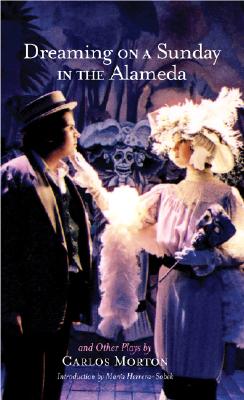
Rancho Hollywood y otras obras del teatro chicano, (1999, Arte Publico Press & Ediciones EL Milagro) is a Spanish language collection of his plays; Dreaming on a Sunday in the Alameda and Other Plays (Chicana & Chicano Visions of the Americas) (2004) on University of Oklahoma Press.

Morton former Mina Shaughnessy Scholar and Fulbright Lecturer to Mexico, Morton holds a M.F.A. in Drama from the University of California, San Diego, and a Ph.D. in Theatre from the University of Texas at Austin. In 1999 he was inducted into the "Writers of the Pass," in El Paso, Texas.


Above, from Morton's "Brown Baby"

INTERVIEW

Ray Rojas (RR): Carlos, last time we updated people on what was "up" with Carlos
Morton, you doing some speaking in Europe back in 2007. What has happened
since then?

Carlos Morton (CM): I went back to Europe this Spring on sabbatical; taught a graduate seminar in Hungary and spoke at several universities in Romania, Poland, and Spain. There is a lot of interest in Chicano/Latino theater in Europe, perhaps more than in the U.S.A. "El Jardin" (play by Morton) has been translated into Polish and Hungarian -- a performance of which I saw in April in Hungary. Although I didn't understand much of it, I laughed along with the audience since I recognized all the action.

I also won the BECA NEBRIJA DE CREADORES (Creative Writing Fellowship) at the University of Alcala de Henares, Spain, where I spent a month in residence writing a play in Spanish called "Frontera Norte."  The prize was 2000 Euros and the publication of the one act play this coming Fall in the Revista CAMINO REAL.

RR: Can you give us a preview of your latest work?

CM: ZONA ROSA The events in this play are based on the life of Dr. Francisco Estrada Valle (1957-1992) whose murder has never been solved. Some events and names have been changed. "Zona Rosa" is an entertainment district in Mexico City where gay people congregate or to quote Vicente Leñero, "La Zona Rosa es un perfume barato en un envase caro" (a cheap perfume in an expensive container).
                                Above, Morton and Russell Copley 
(courtesy of Eaglerock Stage)

RR: You've been doing a lot of cross border networking (with Mexico) within the last 15 years (maybe more). Can you give us your reflections on the violence in Northern Mexico, Cd. Juarez, and the contrary "2nd safest city in the U.S." title that El Paso draws?

CM: My wife (Azalea) and I just came back from a week in Tijuana and Northern Baja California. The tourist areas were ghost towns. No ones goes out after 11 p.m.  The police travel in packs. 

My suegra had her house broken into and we're trying to get her out.  It's a disaster area, 23,000 killed in the last 4 years since Calderon took office.  That is three times the casualties of all the U.S. deaths in Iraq and Afghanistan PUT TOGETHER since 9/11/01. The violence is starting to spill over into Chula Vista, CA. just as it is in El Paso.

RR: Carlos, we just finished another decade in Chicano(a) Lit (2000-2009). What did this decade give to Chicano(a) theater?

CM: We have had new plays by Josefina Lopez (including her movie REAL WOMEN HAVE CURVES), Cherrie Moraga, Luis Alfaro, Jose Cruz Gonzalez, Octavio Solis, and of course the fantastic trio known as CULTURE CLASH.  The Latino Theater Lab in L.A., under the director of Jose Luis Valenzuela, is also doing some fantastic work like Evelina Fernandez's recent piece, SOLITUDE.

RR: What recommendations can you give to someone who wants to give play writing a shot? Is there a text you use in your classes?

CM: I use Playwriting: Writing, Producing, and Selling Your Play, by Louis Catron.  It explains all you need to know about play writing.

RR: With exception of yourself, is there a play by a Chicano(a) playwright we should be giving attention to?

CM: Check out the hilarious NOPAL BOY by Macedonia Arteaga, a real fine example of Chicano humor.

RR: Can you give us a name of an up-and-coming Chicano playwright we should be excited about?

CM: Ray, I put the question to Diane Rodríguez, Associate Producer of New Play Production, Center Theatre Group, Los Angeles. She reads a lot of new work.  Here's what she said:

              "I read very few plays these days from writers that would self identify as Chicana/os. Plays               and writers I'm sure you know already that have recently come  across my desk are:

- "I put the fear of Mexico in 'em" by Matthew Paul Olmos

- "Basilica" and other plays by Mando Alvarado

- "Maelstrom" by Christopher Oscar Pena (Not sure if he is Mex-American)

Tanya Saracho who is Mex American from Chicago via Texas but does not self identify as Chicana

Aside from Mando and Tanya who who are Tejanos I don't even know if Matthew and Christopher are Mexican American and if they are it's doubtful they consider themselves Chicano(a)s.

I (Diane Rodriguez) have a new play that I wrote titled "Living Large in a Mini Kind of Way" that is going to premier in Chicago at Teatro Luna next year. And because I am from that generation that claimed the word Chicana/o, I still identify myself as a Chicana." 

Above, posters courtesy of Eaglerock Stage
More on Eaglerock at www.eaglerockstage.com

CM: So, this leads to a bigger question:  How many young writers identify as Chicanos?  There are some, including a very established El Paso playwright, who thinks we should use the term "Hispanic."

RR: Carlos, in my blogging on chapbooks h in early Chicano Renaissance literature, I mentioned your chapbook White Heroin Winter. My first question, is do you write any poetry now days? Second,
can you describe to our readers how you entered into play writing?

CM: I started out writing and reading my poetry in coffee houses and bars in Chicago and El Paso in the late 1960's and early 1970s.  I loved the immediacy with the audience.  I started writing plays about the same time and found that it gave me more more gratification and recognition.  The excitement and electricity of having a live audience to deal with is what makes both genres worth while in my estimation.


EL PASO WRITER UPDATE

Chicano Moratorium exhibit on view

Speaking of Ruben Salazar, see this story on an exhibit for the Chicano Moratorium: Chicano Moratorium exhibit on view.


Veteran Journalist Joe Olvera Well Done or Medium Rare

The City of El Paso will be honoring veteran journalis and poet, Joe Olvera with its Conquistador Award on July 20 at City Council Chambers. Joe sent me an email say, "I joke that I'm not a Conquistador, just a Conquistado."

Second, there will be a "Cabuleando a Joe Olvera Roast and Fundraiser" at the Cafe Mayapan on Saturday, July 24. Tickets will be $20 a person. It's going to be a fun evening of friends making fun of Joe and "my pompous ways" say Joe.

BorderSenses at 16

The BorderSenses journal has released their 16th volume. They had a release party last night (which I missed, sorry Amit, my car's in the shop).

Blog Posts
Luis Rodriguez sends tiding from England. I posted a post today on his blog.

Coming next week:
Sunday: Small Press Spotlite
 Monday: Lunes con Lalo
Tuesday: Interview with Mike/M. Padilla author of The Girls from the Revolutionary Cantina.


----------------
The link we share with you today is: The Brick Testament. Reading The Bible this way will take you back to your childhood.


Bookmark and Share

Thursday, July 01, 2010

Ballistic Results Official: Gunshots from Cd. Juarez have come to El Paso more than John Cornyn


AP Associated Pest


Ballistic Results Official: Gunshots from Cd. Juarez have come to El Paso more than John Cornyn

by Mando D. Chisme
Posted: 07/01/2010 12:00:00 AM MDT

EL PASO - Ballistics experts said today that gunshots from Cd. Juarez have come to El Paso more than has U.S. Senator John Cornyn.

Gunshots hit the El Paso, Texas city hall building on Tuesday, June 29.

Investigators are sure these shots came from a gun fired from Cd. Juarez, Mexico which is 800-1000 yards from El Paso's City Hall Building.

Cd. Juarez, Chihuahua has been embroiled in a drug war with warring drug cartels since 2008.

“We were astonished to find,” says Juan Balaso, “that in totaling up the number of gunshots that have strayed over the border to El Paso since 1910, they total more than U.S. Senator John Cornyn's visits to the Sun City.”

Cornyn does not have, and has never had, an El Paso office. El Paso is Texas' 6th largest city (or 4th if you count your undocumented tios).

Cornyn's office responded by smoke signals on Wednesday to the Associated Pest's query regarding reasons for having no office along the border, anywhere north of Harlingen, Texas.

Cornyn's press secretary Ottio Morenos said Cornyn will be visiting El Paso soon and will be giving at press conference at the McAllen Miller Airport on Tuesday, Aug. 5, 2010.

“This region, if given state status, would be the poorest state in the union,” says Viva Tirando, ballistics expert investigating the recent gunshots in El Paso.

A mariachi group played at the City Hall building today after the press conference. Violinist, Pepe Fredo E. Menez said, “Cornyn thinks Lubbock is West Texas” before resuming singing, “Sonaron cuatro balazos a las dos de la manana....”


Bookmark and Share

Bullets from Cd. Juarez hit El Paso City Hall: It's like Déjà vu all over again; El Paso Writer Updates on Gilb, Saenz, and Salazar


hit El Paso City Hall: 
It's like Déjà vu all over again

Spectators on roof of the Paso Del Norte Hotel watching 1st Battle of Juarez


With bullets hitting El Paso's City Hall many comparisons are being draw up to the First Battle of Cd. Juarez, the first major battle of the Mexican Revolution.


Tuesday, I think it was, bullets from an Ak-47 crossed over the border despite the wall, and hit El Paso's City Hall. One source told me that one of the bullets entered a room and hit a painting knocking it off the wall. At that point, everyone hit the floor.

I listen to the radio shows yesterday morning and some questioned the distance an Ak-47 bullet can travel and stated that the round had to be sniper.

Above, Revolutionaries near irrigation ditch during 1st Battle of Juarez

On the homepage of today's El Paso Times, they give a diagram showing the trajectory and the article states that is it possible for an AK-47 bullet to stray as much as a mile. Those familiar with El Paso, if you were traveling upriver on the Rio Grande, the river curves northeast right after the Sante Bridge and Chihuahuita. So the radius of of how close you are to Mexico is very great.


In May 1911, when Francisco Madero, Pascual Orozco, and Pancho Villa led an attack on Cd. Juarez, many El Paso Citizens gathered on the El Paso side to watch the battle, many to their detriment.

Many El Pasoan watched from rooftops and train cars. If I remember, about 10 people were killed on the El Paso side from stray bullets.

Just a few months ago, some people were comparing incidents of Nazi Germany to current state in Arizona. It grew some criticism.


Now, there are many comparisons nowadays between the Mexican Revolution in Cd. Juarez and the drug war violence. I'm not much of an advocate of the comparison.  Sure shot are straying over, so the comparisons run, but revolutionaries fighting for tierra y libertad to thugs fighting over drug territories is a far fetch. It's a shame this violence is occurring during the centennial of the Mexican Revolution of 1910.

New Links:


EL PASO WRITER UPDATES


El Paso Writers Mentioned in articles and blogs

Rudolfo Acuna mentions El Paso journalist Ruben Salazar in his article

Mexicans Are Not Dumb: The Schools Fail by Rudy Acuña on

Educational Equity, Politics & Policy in Texas blog: 

 Mexican American journalist Ruben Salazar, killed by Los Angeles Sheriff
deputies while covering the Chicano Moratorium of August 29, 1970,
reacting to educators calling Mexicans “culturally deprived,” wrote in
1963, “Presumably they want to save these poor people terrible void by
giving them culture…What they don’t seem to realize is that Mexican
Americans have a culture…” READ MORE.

Dagoberto Gilb is mentioned by Eric Miles in his interview with Anis Shivani on the Huntington Post: "

"As educational opportunities open up and as minorities become economically and educationally viable, they're telling their stories. Their works, however, are cast off into the category of "minority" fiction. They're stuck on the Literary Short Bus. Fine authors like Dagoberto Gilb, Mark Nesbitt, even Toni Morrison--they're not called great writers."

"They're labeled Minority Writers. The blue collar world is usually associated with white people, Irishmen and Italians and Jews and so forth--peoples who were discriminated against in the late 19th and early 20th centuries. But we're not building railroads anymore, and if we ever do so again, it'll be Hispanics and Blacks doing the dirty work, and they'll be writing the novels about their travails." READ MORE.

Saenz gets Oprah's approval; Saenz on PBS' NewsHour

Benjamin Alire Saenz young adult novel Last Night I Sang to the Monster was named on Oprah.com's top nine books for her Summer Reading List. This book also won the 2010 Paterson Prize for Books for Young People.

Seeing Ben Saenz with the PBS NewHour's footage amazed me.  


"Wealthy people can move anywhere they want. Wealthy people are welcome anywhere in the world, which then we have to say then borders are really to keep out the poor."

                                   ---- Benjamin Alire Saenz, NewHour

                                   READ AND SEE MORE


----------------
NEW ISSUE OF 
"LIBROS, LIBROS" 
IS OUT

Over 50 pages of new and forthcoming books by/on Chicano(a) and Latino(a)s


---------------

TOMORROW: INTERVIEW WITH CARLOS MORTON


The link we share with you today is: MartinEspada.net.


Bookmark and Share